


Periodontist vs. Dentist: Who Should You Go To for Gum Problems?

Updated: Aug 29
The Silent Epidemic Nobody Talks About
Think about the last time you had a toothache. You probably didn't wait long — the pain made sure of that. You called the clinic, booked an appointment, maybe even showed up the same day. Dental pain is impossible to ignore.
Now think about your gums. When did you last actually look at them? Notice whether they bled a little when you rinsed after brushing, or looked slightly puffy around the edges? Most people notice it — a little blood in the sink after brushing, slight puffiness near one tooth, maybe bad breath despite brushing twice a day — and then dismiss it.
“It’s probably nothing.”
“Maybe I brushed too hard.”
“I’ll see later.”
And life moves on.
This is exactly how gum disease steals teeth. Quietly. Without drama. Over months and years, while life continues.
By the time a patient sits across from me and says, "Doctor, my tooth has started shaking" — the damage is often already done. The bone that once held that tooth firmly in place has been dissolving slowly, silently, painlessly. And now the options are limited. This is a conversation I have far too often, and with patients who are not elderly. I see it in people in their 30s and 40s — young professionals, people who brush twice a day — still losing teeth, because no one told them that brushing is not enough if the gums underneath are already infected.
Gum disease is one of the most common — and most neglected — oral health problems in India. Yet most people don’t get their gums checked until something feels seriously wrong.
Why Does Nobody Notice Until It's Too Late?
Because gum disease doesn't operate the way a cavity does. A cavity hurts. A cracked tooth hurts. But periodontitis — the destructive form of gum disease — is remarkably, deceivingly painless until its advanced stages.
The symptoms are easy to explain away:
Bleeding after brushing? I was pressing too hard.
Gums that look a little swollen? Maybe I ate something rough.
Bad breath that won't go away? I'll use more mouthwash.
A tooth that feels ever so slightly different? It'll pass.
None of these individually feel like an emergency. Together, they are a clinical picture of active, progressing gum disease. The damage happens silently, well below the gum line, where you can't see or feel it. By the time a tooth becomes loose, significant bone has already been lost — and at that stage, even the most skilled periodontist faces a difficult decision about whether the tooth can be saved.
This is why the most dangerous thing about gum disease isn't the disease itself. It's the delay.
Your Gums Are a Window to the Rest of Your Body
Many patients are surprised when I tell them this:
Your mouth and your body are deeply connected. Chronic gum infection creates ongoing inflammation in your body. Research has linked gum disease with conditions such as:
Diabetes
Heart disease
Stroke
Poor blood sugar control
If your gums are constantly infected, your body is constantly fighting that infection.
Treating gum disease isn’t just about saving teeth. Sometimes it’s about reducing a chronic inflammatory burden on your entire body.
What Is a Periodontist — And How Are They Different from a Dentist?
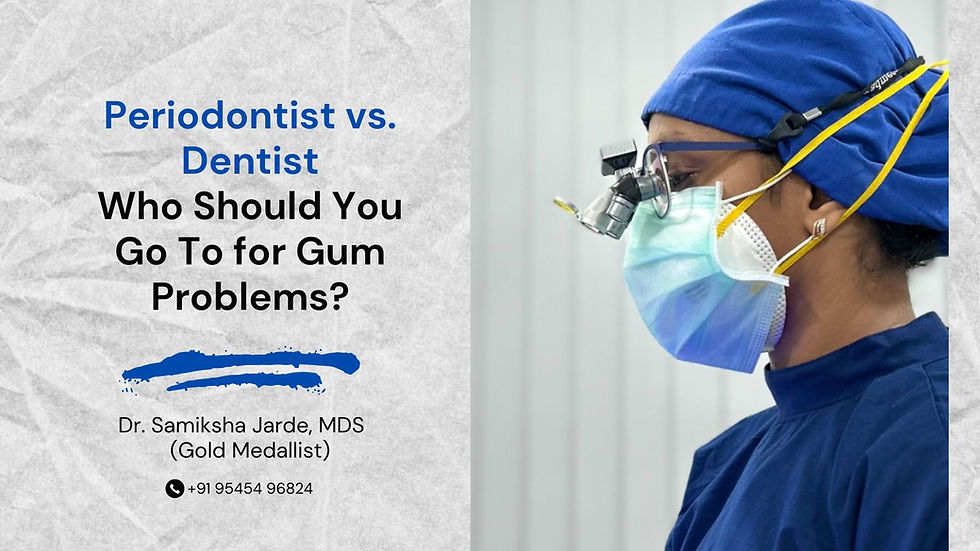
A general dentist is your first point of dental care. A periodontist, on the other hand, is a gum specialist. After becoming a dentist, a periodontist undergoes 3 additional years of advanced MDS specialist training focused only on:
Gums
Bone supporting teeth
Gum surgeries
Bone grafting
Dental implants
Think of it this way: Your general dentist is like your family physician. A periodontist is the specialist you see when the problem has gone deeper.
One thing most patients don't realise: even a routine teeth cleaning done by a periodontist is a different experience from a standard dental cleaning. A periodontist examines pocket depths, bone levels, and gum architecture that a routine cleaning appointment may not fully assess. It is not just about removing tartar — it is about understanding what is happening below the surface and catching it before it becomes irreversible.
When Patients Finally Visit Us…
At DENTALK® Speciality Dental Clinic, patients rarely walk in saying: “I think I have gum disease.”
Instead, they say things like:
“Doctor, my gums bleed while brushing.”
“My breath doesn’t stay fresh.”
“My teeth look longer.”
“One tooth feels loose.”
“Cold water suddenly hurts.”
And many are surprised when we explain that all of these may point toward the same underlying issue — gum disease.
Do You Recognise Any of These?
Read slowly.
You may relate to more than one.
🔴 Yellow Teeth or Visible Deposits
"I can see something yellowish or brownish stuck to my teeth near the gums. I try to brush it off but it won't go."
That's tartar — also called calculus. It starts as soft plaque but hardens over time into a rough, porous deposit that no toothbrush can remove. Once tartar forms, it becomes a surface where more bacteria stick, thrive, and release toxins directly into your gum tissue.
Many patients assume yellow or stained teeth are just a cosmetic issue. But visible tartar near the gum line is almost always a sign that a professional cleaning is overdue — and that the gums underneath need to be assessed, not just the teeth on top.
🔴Bleeding Gums After Brushing
“I spit a little blood while brushing. I think I brush too hard.”
This is probably the most common statement I hear. Here’s something important:
Healthy gums do NOT bleed.
Not while brushing.
Not while flossing.
Not even a little.
Bleeding usually means inflammation caused by plaque and bacteria around the gum line.
Good news? At this stage, the problem is often completely reversible. The problem is most people ignore it. To know more, why do your gums bleed when you brush. click here.
🔴 Swollen or Puffy Gums
“My gums look swollen, but they don’t hurt.” That’s exactly why people delay treatment.
Swelling is often a sign of active infection. Even if it doesn’t hurt, bacteria may already be affecting deeper structures. What feels mild on the surface can be much more serious underneath.
🔴 Bad Breath That Won’t Go Away
“I brush twice daily and still feel conscious about my breath.”
Many patients try:
Mouthwash
Tongue cleaners
Fancy toothpaste
Breath mints
The smell improves briefly… then returns. Why? Because surface products cannot reach bacteria living deep inside gum pockets. Some patients even start avoiding close conversations, meetings, or social situations because they feel self-conscious. If bad breath persists despite good brushing, the cause may be in your gums. To know more about bad breath, click here.
🔴 Receding Gums
“My teeth look longer than before.”
This often comes with sensitivity.
Many first notice it while:
Drinking cold water
Eating ice cream
Having sweets
Suddenly there’s a sharp uncomfortable sensation. That happens because gums have pulled back and exposed the tooth root. Here’s what many people don’t know:
Receded gums do not grow back naturally.
The cause could be:
Aggressive brushing
Teeth grinding
Gum disease
Bone loss
And each requires a different treatment approach.
🔴 Loose Teeth
“Doctor… I can’t explain it, but one tooth feels different while chewing.”
This symptom scares people — and rightly so. A loose tooth often means significant supporting bone has already been lost. This is usually the final stage of a long process that started much earlier with:
Bleeding
Swelling
Bad breath
Recession
A loose tooth should never be ignored. Early treatment can sometimes still save it.
🔴 Deep Gum Pockets
Sometimes patients say:
“My dentist mentioned pocket depth… I didn’t understand what that meant.”
When we check your gums, we measure the space between tooth and gum.
Healthy depth is typically 1–3 mm.
Deeper spaces create pockets where bacteria hide.
Your toothbrush cannot clean these areas.
The dangerous part? Most patients feel nothing at all.
No pain. No warning.
Only a clinical examination reveals it.
🔴 Gummy Smile
“I show too much gum when I smile.”
Some think this is only cosmetic.
But excessive gum tissue can also:
Make teeth look shorter
Affect smile aesthetics
Make cleaning harder
Increase plaque accumulation
A periodontist can improve this with procedures like:
Gum recontouring
Crown lengthening
What Can Be Done — Treatment Options
If you recognised yourself in any of the symptoms above, the most important thing to know is this: most gum problems are very manageable when caught in time. The treatment depends entirely on how far the disease has progressed — which is why a proper assessment comes first.
Depending on what we find, treatment at DENTALK® may include:
Professional deep cleaning (scaling and root planing) — Going beyond a standard cleaning to remove bacterial deposits from below the gum line. When done by a periodontist, this is a significantly more thorough and targeted procedure than a routine dental cleaning.
Gum recontouring and crown lengthening — For gummy smiles, uneven gum lines, or preparation before cosmetic work.
Gum grafting — For receding gums, to rebuild lost tissue and protect exposed root surfaces.
Periodontal flap surgery — When deep pockets cannot be managed with cleaning alone, the gum is gently opened to allow direct access to the bone and root surface.
Bone grafting — When bone has been lost around teeth, graft material is placed to stimulate regeneration and restore support — or to prepare a site for a dental implant.
Dental implants — For teeth that could not be saved, implants placed by a Periodontist and Oral Implantologist ensure the bone and gum environment around your implant is properly evaluated and managed from day one.
No two patients are the same. After a thorough assessment, we will map out exactly what your gums need — and what they don't. Nothing more, nothing less.
Why Choose DENTALK® for Gum Treatment in Pimple Saudagar?
Specialist Leadership. Your care is planned and delivered by Dr. Samiksha Jarde — MDS Gold Medalist, Periodontist and Oral Implantologist. Not a general practitioner offering gum treatment on the side.
Magnification-Assisted Dentistry. We use precision loupes that allow us to see and treat at a level of detail the naked eye simply cannot match — cleaner work, better outcomes, less tissue trauma.
No-Rush Philosophy. We do not compress appointments or skip steps. Anxious patients, patients who've had difficult experiences elsewhere, and patients with longstanding gum concerns are exactly who we built this practice for.
Honest, Education-First Conversations. We explain what we find and why it matters — clearly, without pressure. You leave understanding your own mouth better than when you walked in.
Accessible Location. Conveniently located for patients from Pimple Saudagar, Wakad, Rahatani, and the Kunal Icon Road area — specialist-level gum care right in your neighbourhood.
Frequently Asked Questions
Can my regular dentist treat gum disease?
For early-stage bleeding gums and mild inflammation, yes — a general dentist can help. But once gum disease involves bone loss, deep pockets, loose teeth, or the need for surgical treatment, you need a periodontist. If you've been searching for a periodontist in Pimple Saudagar or a periodontist near me after noticing these symptoms, DENTALK® is exactly where you need to be. Many general dentists across Pune refer their patients to us precisely for this reason.
Is gum treatment painful?
This is the question almost every patient asks — and the answer genuinely surprises most of them. With modern local anaesthesia and a No-Rush approach, gum treatment at DENTALK® is far more comfortable than people expect. We do not begin any procedure until you are completely settled. Post-treatment sensitivity, where it occurs, is temporary and well-managed. Anxious patients are especially welcome here.
My gums bleed only sometimes. Is that still a problem?
Yes — and the word "only" is doing a lot of work in that sentence. Intermittent bleeding still means active inflammation. The condition does not quietly resolve between episodes — it simply waits. Catching it now means a straightforward visit. Ignoring it means a far more involved treatment down the line. If you're unsure, book a periodontal assessment with a periodontist in Pune before it becomes a bigger decision.
Can receding gums grow back on their own?
No. This is one of the most important things to understand about gum health — tissue that has receded will not return without clinical intervention. The earlier it is addressed, the less treatment is needed and the better the long-term outcome. Don't wait for the sensitivity to become unbearable.
Do I need a referral to visit DENTALK®?
No referral needed at all. Whether your dentist recommended you see a periodontist in Pimple Saudagar, or you found us while searching for a periodontist near me — you can book directly. You're equally welcome either way.
I've been told I don't have enough bone for an implant. Is that final?
Not necessarily. Bone grafting can restore lost volume and make implant placement possible in many cases that were initially ruled out. Before you accept that answer, come in for a specialist assessment at DENTALK®. A second opinion from a qualified Implantologist in Pune could change the outcome entirely.
Before You Close This Tab
If you recognised yourself anywhere in this blog — the bleeding you've been explaining away, the sensitivity you manage with warm water, the breath you can't solve with mouthwash, the tooth that doesn't feel quite right — please don't let this be another article you read and move on from.
Gum disease doesn't arrive with a dramatic warning. It advances quietly, month by month, below the surface, until one day the consequences are impossible to ignore and significantly harder to reverse. The difference between a simple cleaning and a complex surgery is almost always just timing.
If you've been putting off finding a periodontist near me, or wondering whether your gum concerns are serious enough to act on — they are. Come in. Get assessed. Know exactly where you stand.
📞 Call or WhatsApp: +91 95454 96824
🏥 Clinic: DENTALK® Speciality Dental Clinic, Pimple Saudagar, Pune.
🔍 Serving: Pimple Saudagar • Wakad • Rahatani • HInkewadi
Explore Our Specialised Gum Treatments
To understand why bleeding gums should never be ignored, read our detailed patient guide on why your gums bleed when you brush.
If your gums have been pulling back and your teeth feel sensitive, learn about receding gums treatment in Pimple Saudagar and how grafting can restore what's been lost.
For patients with deep pockets and advanced gum disease, periodontal flap surgery in Pimple Saudagar offers a precise, surgical solution to eliminate infection and stop further bone loss.
If a tooth feels loose or your bone levels have dropped, our loose teeth treatment in Pimple Saudagar focuses on saving every tooth that can still be saved — before it's too late.


