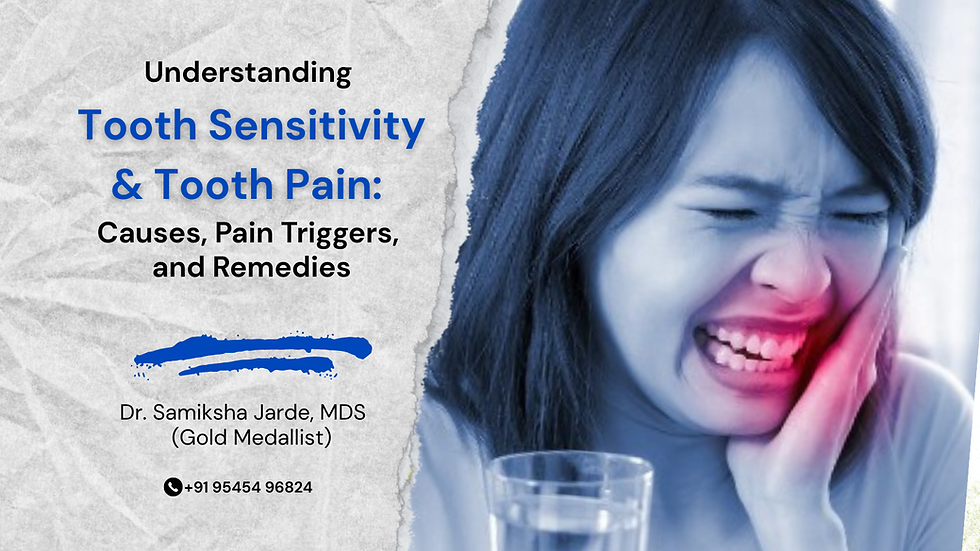
Understanding Tooth Sensitivity and tooth Pain: Causes, Pain Triggers, and Remedies

Updated: Apr 18
Tooth sensitivity and tooth pain are more common than you think. Many people feel a sudden “zing” of discomfort when drinking something cold or experience pain while chewing — yet they ignore it until it becomes unbearable.
If you’ve ever wondered why your teeth hurt, why sensitivity keeps coming back, or what you can do to stop it, this guide is for you.
Let’s dive in.
What Exactly Is Tooth Sensitivity?
Tooth sensitivity — also called dentin hypersensitivity — occurs when the inner layer of the tooth (dentin) becomes exposed.This layer contains tiny tubules that lead directly to the tooth nerve. When uncovered, even mild stimuli like water, sweets, or brushing can send sharp, sudden pain.
You may experience:
Pain with hot or cold drinks
Discomfort while brushing
Sensitivity to sweets or acidic foods
Pain when breathing in cold air
Occasional headaches or jaw strain (if grinding is involved)
Sensitivity is a symptom, not a disease. Understanding the cause is the key to stopping it.
Common Causes of Tooth Sensitivity and Tooth Pain
1. Enamel Erosion
Enamel is the protective layer of your tooth. Once it thins out, dentin gets exposed.Reasons for enamel wear:
Acidic foods and drinks
Excessive brushing
Hard-bristled toothbrush
Teeth grinding (bruxism)
2. Gum Recession
When gums pull back, the root surface — which has no enamel — becomes exposed, leading to sensitivity.
3. Cavities / Cracked Teeth
Decay or cracks allow hot, cold, and sweet foods to reach the nerve more easily, causing sharp pain.
4. Recent Dental Treatments
Scaling, whitening, fillings, and crown work may cause temporary sensitivity — usually lasting a few days.
5. Bruxism (Teeth Grinding / Clenching)
Grinding causes:
Enamel wear
Micro-cracks in teeth
Gum recession
Jaw pain
All of which increase sensitivity.
6. Gum Disease
Inflamed or infected gums expose tooth roots and cause both sensitivity and dull, persistent pain.
Common Pain Triggers You Should Notice
You may feel tooth pain when:
Drinking hot or cold beverages
Eating sweets or sour foods
Brushing or flossing
Chewing hard foods
Biting down (a sign of cracks or infections)
Exposing teeth to cold air
The pattern of pain tells us a lot about the underlying issue.
Simple Remedies for Relieving Tooth Sensitivity
If your symptoms are mild or occasional, try these home care steps:
Use Desensitizing Toothpaste : Helps block sensitivity signals from reaching the nerve. Visible relief often comes in 1–2 weeks.
Switch to a Soft-Bristle Toothbrush: Avoid aggressive brushing. Gentle circular motions work best.
Avoid Highly Acidic Foods and Drinks : Sodas, lemon water, sports drinks, vinegar-based foods, etc.Tip: Drink through a straw and rinse after meals.
Try Warm Salt-Water Rinses : Reduces inflammation and bacteria.
Avoid Cold Air Directly on Teeth : Especially if you have gum recession.
Stop Over-brushing : Over-cleaning damages enamel more than it helps.
Use a Night Guard (If You Grind Teeth) : This protects enamel and reduces nerve irritation.
These methods help — but only temporarily if the cause is not treated.
When Should You See a Dentist for Sensitivity or Pain?
Book a dental visit if:
Sensitivity lasts more than 7–10 days
Pain is spontaneous or worsening
You feel pain while chewing
You notice gum recession or bleeding
You suspect a cavity or cracked tooth
Your sensitivity is affecting daily life (food choices, sleep, comfort)
Ignoring symptoms can lead to:
Deep decay
Root canal infection
Severe gum problems
Tooth fracture requiring extraction
Early treatment = painless treatment.
Professional Treatments We Offer for Tooth Sensitivity
Depending on the cause, we may recommend:
Fluoride varnish treatment - Strengthens enamel and reduces sensitivity.
Desensitizing coatings / bonding - Seals exposed dentin and protects nerves.
Fillings or restorations - If decay or cracks are the issue.
Gum treatment - For sensitivity due to recession or gum disease.
Night guard fabrication - For grinding-related sensitivity
Root canal treatment - If the nerve is infected or inflamed.
Our focus is always on minimally invasive, conservative dentistry — treating the exact cause, not just the symptoms.
Why Choose Dentalk® for tooth sensitivity & tooth pain in Pimple Saudagar?
Expert Diagnosis by MDS (Gold Medalist) : Dr. Samiksha Jarde (MDS, Gold Medalist) uses dental loupes to view minute details that cannot be seen with the naked eye. This ensures early, accurate diagnosis of enamel wear, cracks, cavities, and gum issues, supported by digital X-rays for complete clarity..
Advanced Technology : Our treatments use loupes-based magnification, laser dentistry (when required), and high-quality desensitizing materials for precise, gentle, and long-lasting results.
Comfort-Focused Care : We listen carefully to your concerns and explain everything clearly. With painless techniques and a calm environment, we ensure a stress-free treatment experience.
Long-Term Relief Plans: We guide you on brushing techniques, enamel protection, diet changes, and preventive steps so your sensitivity does not return.
Trusted dentist in Pimple Saudagar: With honest communication and consistent results, we are trusted by 1500+ families in Pimple Saudagar for managing tooth sensitivity and dental pain.
Frequently Asked Questions
When is tooth sensitivity a sign that I need a Root Canal?
If your sensitivity is brief (lasting seconds) after cold water, it may be enamel wear. However, if the pain is lingering, spontaneous, or occurs with hot foods, the nerve may be infected. As a specialist, Dr. Samiksha Jarde and her team performs precision Root Canal Treatment in Pimple Saudagar at DENTALK® to save the natural tooth and stop the pain permanently.
What are the most common triggers for sudden tooth pain?
Triggers often include extreme temperatures, acidic fruits, or even cold air. At DENTALK® Speciality Dental Clinic, we use high-magnification loupes to find the "hidden" causes of these triggers, such as micro-cracks, gum recession, or deep-seated cavities that standard exams might miss.
Can tooth sensitivity be cured at home?
Desensitizing toothpastes can manage mild symptoms, but they only mask the problem. Dr. Samiksha Jarde, MDS (Gold Medalist), recommends a professional clinical evaluation to ensure the sensitivity isn't a warning sign of underlying nerve infection or a failing filling. Early diagnosis at our Pimple Saudagar clinic often prevents the need for more complex treatments later.
Final Thoughts: Don’t Ignore Your Teeth's SOS
Tooth sensitivity and tooth pain are signals—not problems you should ignore. Whether it is a sharp sting from a cold drink or a dull ache, most causes are highly treatable when diagnosed early. Taking action now can save you from more complex procedures and help you maintain your natural smile for life.
If you’ve been experiencing sensitivity or pain for more than a few days, don’t wait for the discomfort to escalate. Finding a trusted dentist near me is the first step toward relief. Book your dental check-up today to protect your teeth before a minor issue becomes a serious dental emergency.
Get Relief Today
Stop enduring the pain and start enjoying your favorite foods again with professional, specialized care.
👉 Book Your Evaluation: https://calendar.app.google/2K1AhKL8hdzHCUzh7
📞 Call or WhatsApp: +91 95454 96824
Visit us at DENTALK® Speciality Dental Clinic, Vision 9 Mall, Pimple Saudagar, Pune.
Still Not Sure? Read More
Expert Guide: How to Find the Best Dentist in Pimple Saudagar
Root Causes: Understanding Tooth Sensitivity and Effective Remedies
Prevention: The Importance of Early Diagnosis for Healthy Teeth